Why Piano Duets Matter
Last time I wrote about a child who wouldn’t read the score. About a boy who hunted for music with his fingers instead of properly learning to play from the page, the way everyone else did. Today I want to talk about what finally brought him closer to that notation — but mostly, closer to the music itself.
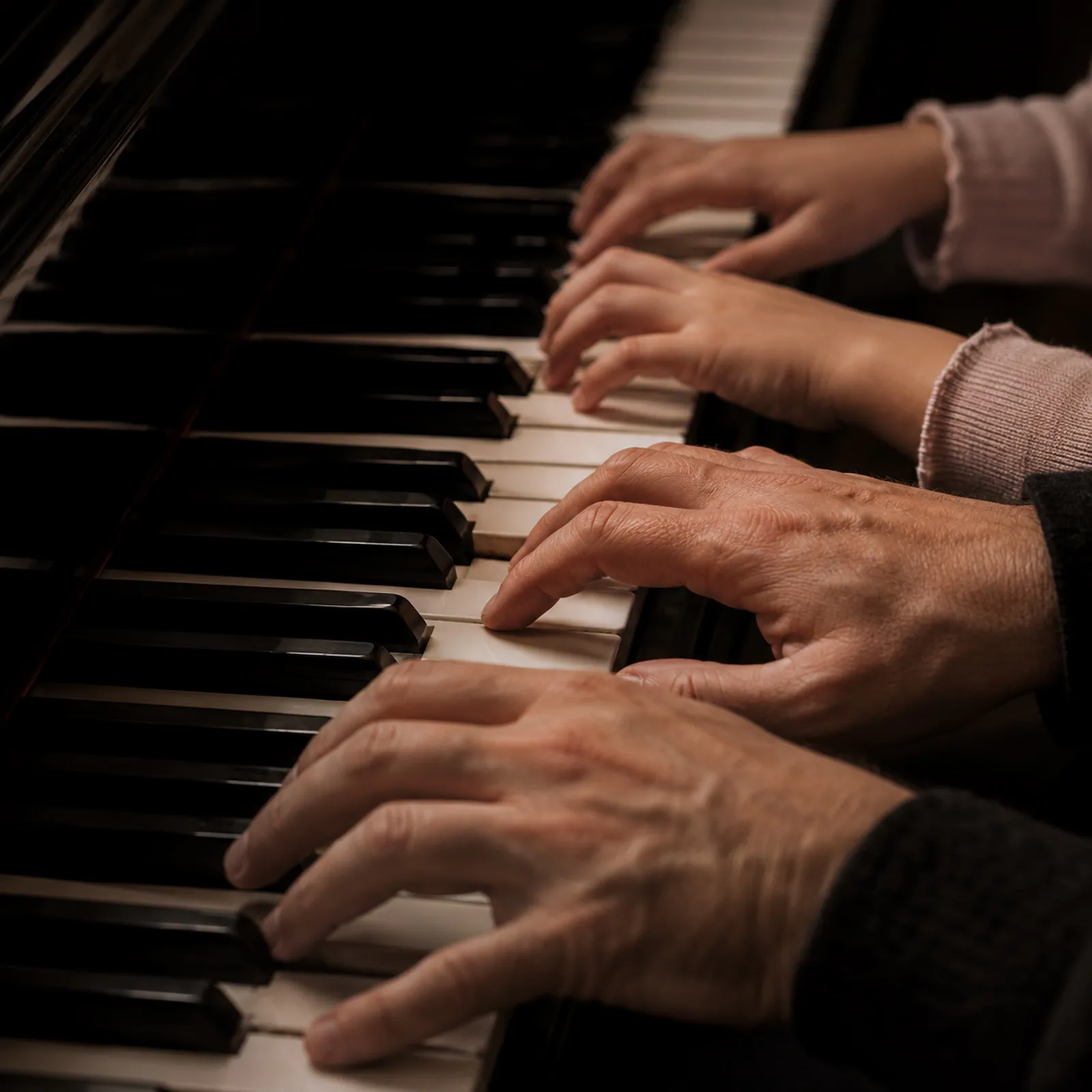
It wasn’t different, better sheet music. It was a second pair of hands on the same piano.
A beginner at the piano lives in a very narrow world. The right hand plays a simple melodic line. The left adds a few accompanying notes, mostly down in the octave just below middle C. That whole world fits inside about forty centimetres of the keyboard — and the piano holds so much more than that.
Nobody tells a beginner what the instrument can actually do, sound-wise. That’s something he still has to wait for.
Until, one day, he sits down to a four-hand piece.
I remember that first duet with complete precision — not the title, I’ve lost that, but the feeling, yes. My teacher sat down beside me and started playing the lower part. Suddenly there were basses coming out of that piano I’d never heard before. Harmonies filling in my simple melody from below — it was a whole different level. I wasn’t playing alone anymore. I was part of a sound that was bigger than anything I’d known until then.
It felt like an orchestra. Not because other instrumental colours were suddenly in the room — but because, for the first time, I was hearing the piano sound across its whole range.
Back then, the entire country learned from one and the same piano method — the Russian Piano School, as everyone called it. It happened to contain a surprising number of four-hand pieces. I don’t know if that was deliberate on the authors’ part or just a happy accident, but because of it, the chance to play four-handed came around fairly often — whenever there was someone older nearby to play with.
I can’t say for certain whether it fundamentally changed my overall relationship with music school. I was eight, nine years old — you don’t take stock of your life like that at that age. But that feeling — that specific feeling of fullness in the sound — kept coming back, every single time. And that, on its own, is fairly strong evidence that something was working.
From a pedagogical point of view, we understand a little more today about what was actually happening. A young mind that struggles to hold onto its own internal rhythm can respond surprisingly well to a rhythm coming from outside itself. My teacher’s hands in the lower register weren’t just prettier harmonies. They were also an external pulse — something to lock onto, while my own internal pulse wasn’t yet steady enough to rely on.
The child from my last post probably needed that outside pulse more than most of his classmates did. And playing duets gave it to him exactly when he needed it.
If you teach piano and you have a student who constantly fights the metronome, try simply sitting down next to him instead. Sometimes it isn’t a question of discipline at all. It’s a question of whether the child actually feels a living pulse he’s meant to follow — or just hears one ticking away, mindlessly, somewhere beside him.
Happy practicing, friends.
Read Next
Motivating the Modern Student
The Child Who Wouldn't Read the Score
Get a free piano piece.
Subscribe and receive a free digital PDF of an original piano composition — plus occasional updates on music, photography, and ideas from the road.