Motivating the Modern Student
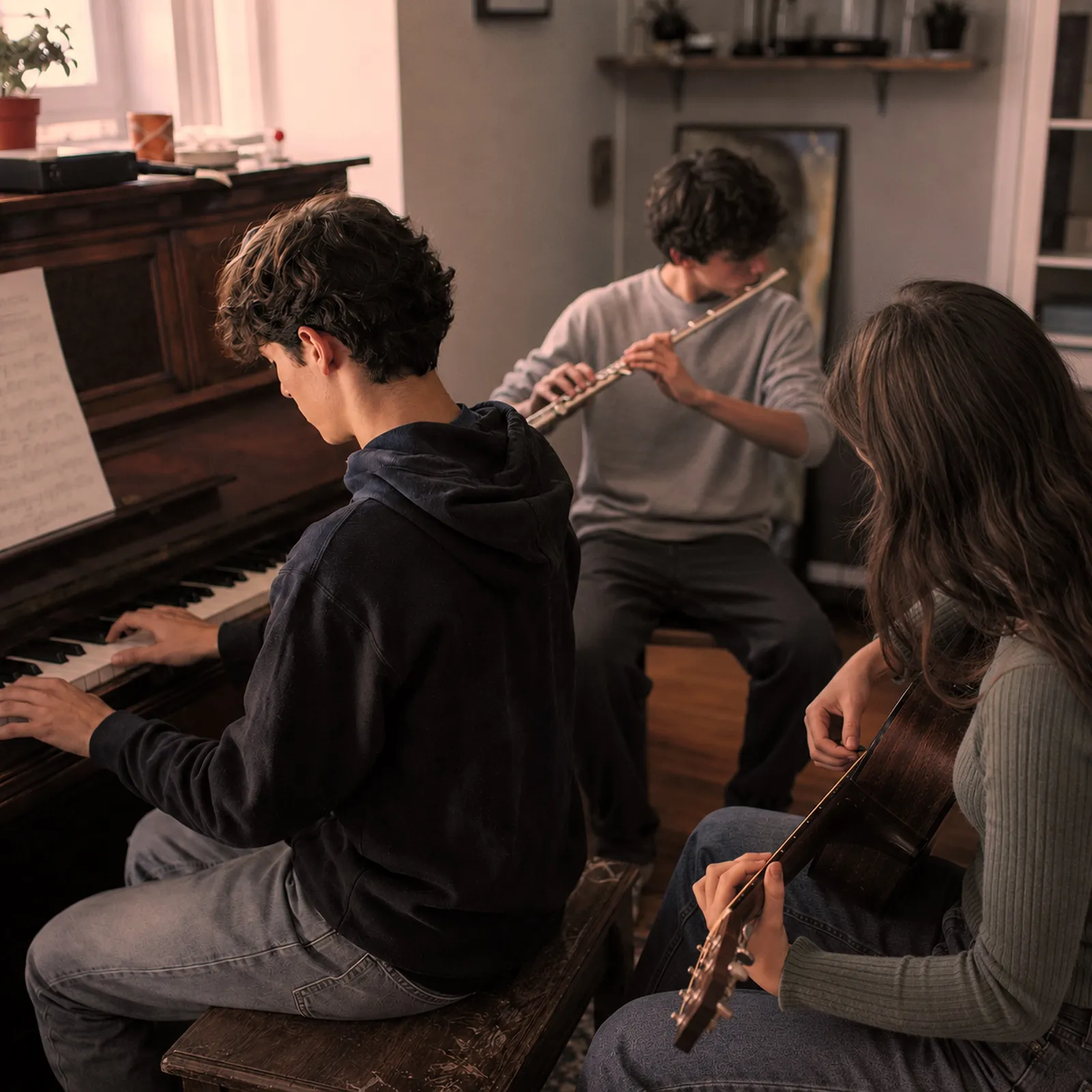
In my last post, I was chasing an answer to a question: what actually keeps a restless child tied to music? Playing duets helps enormously. But it might not be enough on its own.
In my case, real love for music arrived a few years later — and back then, it had nothing to do with classical piano repertoire at all.
I was a bit older by the time I started playing Elán, Olympic, and Žbirka songs with a friend. Not from sheet music, not at school — we’d just sit down and work out what we could play from memory. And when our guitar teacher later let us play old blues standards together with the other kids, something clicked into place inside me in a completely different way than it ever had with Czerny’s piano études.
I can’t reduce it to a single cause. It was probably a combination of two strong things happening at once: I was playing with someone else, and I was playing music I already knew and loved. Neither one alone would likely have been enough — but together, it worked brilliantly.
This is usually the point where a lot of teachers assume I’m reopening the old, eternal argument between “serious” and “popular” music. No — that’s not what I mean at all.
It’s something simpler, but deeper: the brain needs an emotional connection to sound before it’s willing to invest discipline into mastering it. Not instead of discipline — but ahead of it. Elán and Žbirka didn’t give me technique. I had that from elsewhere. What they gave me was a real reason why that technique was worth using at all.
Research into motivation today backs this up fairly clearly: music a person chooses for themselves, carrying genuine personal emotional weight, drives motivation far more strongly than any carefully assembled repertoire — however pedagogically perfect that repertoire might be. This isn’t an argument against the classical repertoire. It’s an argument about priorities.
Today’s student carries very similar emotions and motivation to what I had back in the eighties. But the world around him is completely different.
Back then, I had to memorize whatever I’d heard, or replay it again and again on a cassette player until it stuck. Today’s child has access to any recording, by any artist, at any moment — through the phone in his own pocket. The competition for his attention is fierce, and it isn’t another kid with a guitar. It’s an algorithm, offering him exactly what he wants to hear, every fifteen seconds, with no effort at all.
That doesn’t mean motivation is dead. It means a classical music teacher today is up against a far stronger opponent than my guitar teacher ever was.
But that exact same power can be turned around. The same phone that distracts a child can, in seconds, find the piece that makes his eyes light up — you just have to ask him, and actually listen to the answer. Competition turns into an ally the moment a teacher stops treating it as the enemy and starts using it as a tool — and that’s something I want to come back to in my next post.
So — what does this actually mean in practice? Not throwing out the classical repertoire. But being willing to ask a student what music he actually likes — and finding a way to let it into the lesson, even briefly, even just as the cherry on top. Not because popular music is better. But because an emotional connection to sound is the gateway to discipline, not a substitute for it.
I found my own way to discipline through Olympic and old blues. Today’s child will find his own way there through something else. It isn’t the teacher’s job to decide whether that “something else” is good enough or worthy of attention. It’s more about the ability to go looking, and find out what it actually is.
Happy practicing, friends.
Get a free piano piece.
Subscribe and receive a free digital PDF of an original piano composition — plus occasional updates on music, photography, and ideas from the road.