The Child Who Wouldn't Read the Score
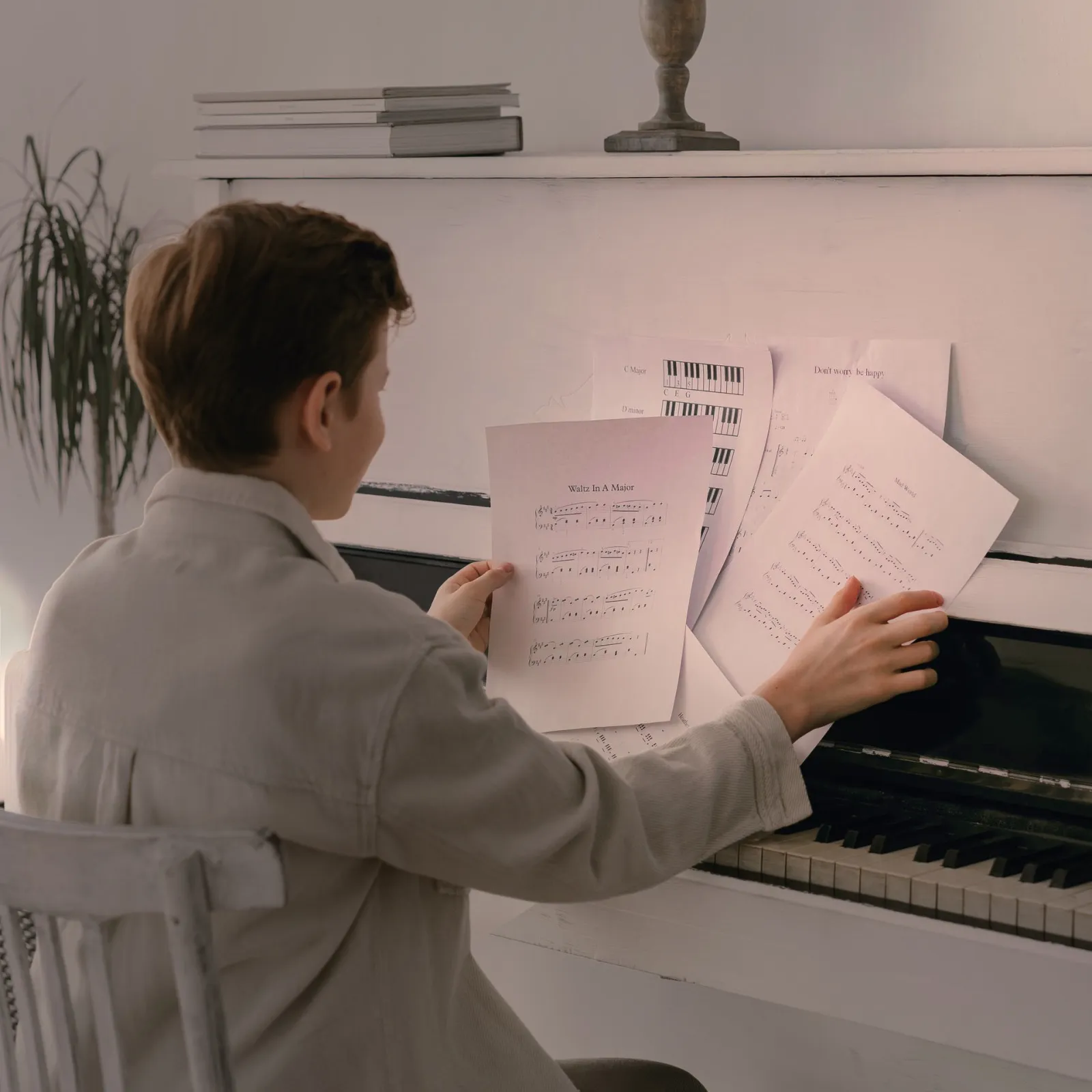
The most enjoyable part of playing the piano was always the same for me. Not learning to tap out the notes correctly on the keys. Not getting through a piece without mistakes. But finding the music and the sound with my fingers — moving along the keys, trying things, searching, until it started to sound like something. That physical, hands-first exploration of sound: the tones, the melodies, hunting for the keys that hold them and wait to be found.
Fingering didn’t interest me. Finding the sound did.
There was just one small flaw in this — from my piano teacher’s point of view, it wasn’t remotely the right approach.
Fingering numbers exist in sheet music for a good reason. They show which finger plays which note, so the technique stays clean and efficient. Without correct fingering, the underlying motor habits simply don’t develop the way they’re supposed to.
My teacher noticed fairly early on that I almost never knew where I was in the score if she pointed to it. Not because I wasn’t paying attention. But because I genuinely wasn’t using the notation much at all. I played from memory, by ear, playing what I wanted to hear — and the sheet music, frankly, was mostly just in my way.
And once she’d figured this out about me, she was, truth be told, not thrilled about it in the slightest.
I remember moments when she called other teachers into my lessons — she simply needed witnesses. She needed someone to confirm that this child really was as difficult a case of disobedience as he seemed. The boy ignored the notation. He played his own way. Stop him, and he couldn’t show you where he was. And when she played a phrase back with the correct fingering, he could repeat it — but only after he’d heard it. Not from the page. From the sound.
Music school in the 1970s ran on a clearly defined system. Practically every student in Czechoslovakia learned from the same piano method, in the same sequence, at the same pace. The system was good. It worked for most children. It just wasn’t built for every kind of “head.”
I understand her completely now. She had a pupil in front of her whose behaviour made no sense within what pedagogy had to offer at the time. He wasn’t lazy — he was playing. He wasn’t trying to misbehave — he was enjoying himself. But the moment she asked him about the notation, she hit a wall. There was nothing back then to suggest what was actually going on. There was no right question to ask. And without the right question, naturally, no right answer ever came.
I know I was a difficult student. And I know she tried.
Research into attention and motivation today describes something that simply hadn’t been clearly worked out in the 1970s. The brain looks for reward. It looks for something that instantly confirms the energy it just spent was worth spending. Reading notation that doesn’t yet make a sound — black symbols on white paper that imagination and motor skill can only slowly, awkwardly turn into music — for some brains, this offers no reward at all.
Finding the music with your fingers did provide that reward. Every tone discovered, every melody found not on the page but straight from the keys — that was the reward. Small, immediate, real. And that particular head needed it before it could take in anything else.
Today this kind of behaviour has a name. It’s called ADHD. Back then, in 1970s Czechoslovakia, that name essentially didn’t exist in the context of a music school. My teacher wasn’t looking at a diagnosis. She was looking at a child who wouldn’t behave.
That disobedient child later went on to study at the Bratislava Conservatory. He wrote a suite that survived thirty-six years in other people’s classrooms without his even knowing it existed. And now, finally, that same suite is about to get its real release.
I’m not telling this story to prove I was right and my teacher wasn’t. She was right, within her own time and place, given what she knew and what she had to work with. I’m telling it so this much is clear: there was potential in that child. He wasn’t a problem — he was simply a question that needed a different approach.
And what finally drew him to music for good wasn’t a better teaching method or a different textbook. It was something far more concrete. But that’s a story for next time.
Happy practicing, friends.
Read Next
Why Piano Duets Matter
When They Call You Mad
Get a free piano piece.
Subscribe and receive a free digital PDF of an original piano composition — plus occasional updates on music, photography, and ideas from the road.