Knowing You'll Pause
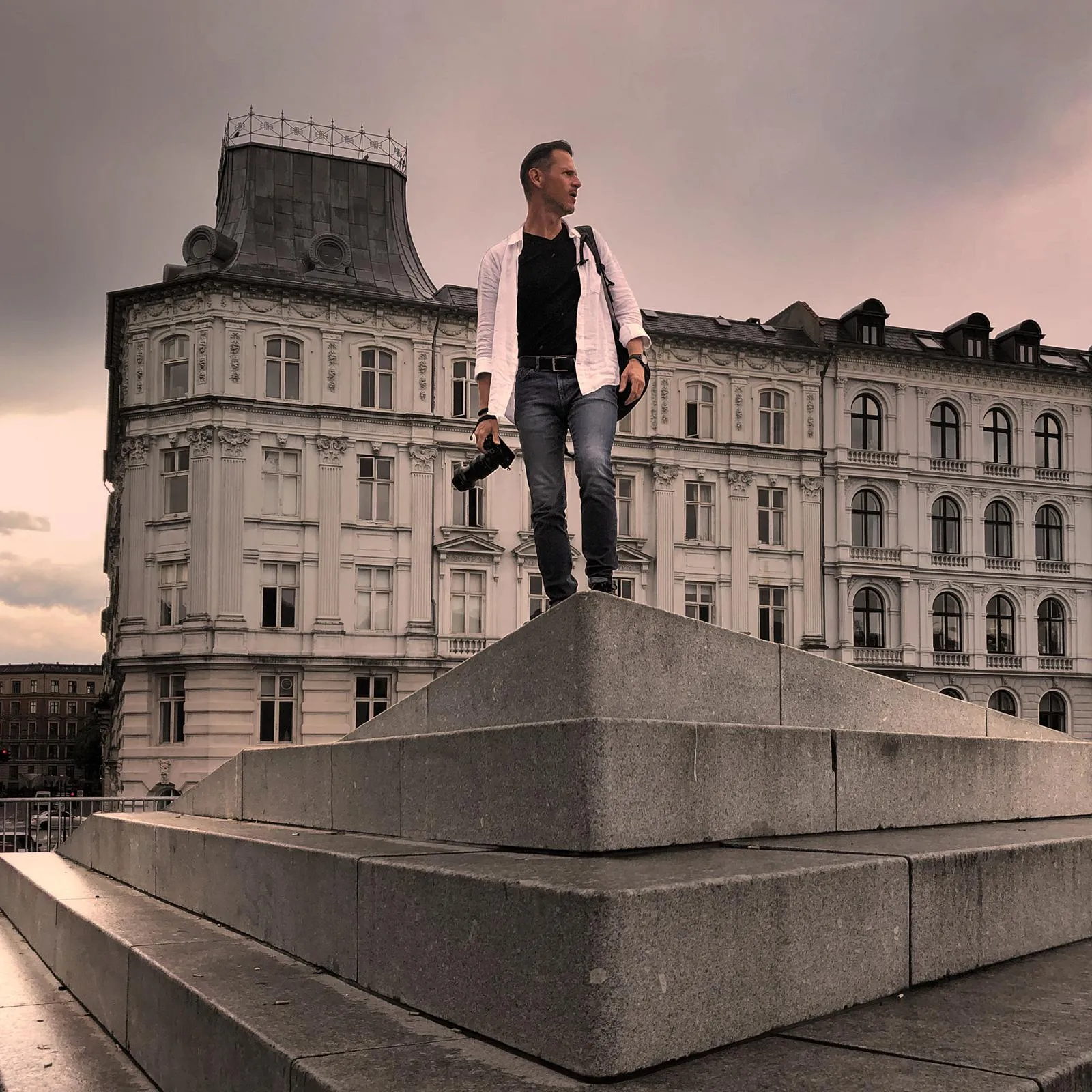
Most of us travel with a phone in hand. You see something you like, you tap out a couple of frames, and you keep walking. The pictures work as a backup for your own memory, and there’s nothing wrong with that.
But a camera works differently.
Not technically. The way you actually look at the same place changes. Carry a camera and you know you’re going to stop somewhere. You don’t know when, you don’t know where — but you will stop. That anticipation reshapes the whole way you move through a city or a landscape. You start noticing things you’d otherwise have walked straight past. Light on the tip of a church spire. An old woman by a window. A shadow that makes no obvious sense.
A camera is a shortcut to full attention. You don’t need to be a meditation master first.
I grew up around photography. Literally.
My grandparents had a simple black-and-white camera that shot 6×6 roll film. Prints weren’t sent off to a lab — the negative was pressed against photo paper between two sheets of glass in a darkened room, exposed to light for a second, and what came out was a contact print, 1:1. Primitive, precise, thrilling.
My parents had a real darkroom. An enlarger, the developer and the fixer, a print glazer for the finished photos — everything, up to A4 size. My mother once won a local photography competition with a shot of a snowy path. A view from a window. Footprints in the snow. Nothing more than that. A beautiful diagonal composition, and a winning photograph.
My own first camera was a small, boxy Russian thing, also shooting 6×6. I was about seven. Fixed aperture, fixed focus — not unlike a GoPro, really. Then came a Ljubitel, a Czech copy of the Flexaret. And around fifteen, my first real SLR, a Zenit with a built-in light meter. Everything black and white. Colour slide film existed, and we occasionally shot it, but projecting it needed a darkened room, which made it impractical. Colour prints were either expensive or didn’t last. Black and white wasn’t an aesthetic choice. It was simply our reality.
But I only understood what photography actually does to how you see the world much later.
I was about forty-six the first time I went abroad on a real trip — not a work trip, not the usual kind of holiday. There hadn’t been time before, or money, or simply a different shape of life. Lisbon was the first.
I remember it precisely. I walked the city with a camera, my head full of everything I still wanted to see and catch. Not rushed — quite the opposite. I moved with that particular kind of focus that comes from knowing you can stop anywhere, whenever it’s needed. You just never know in advance where.
And then I stepped into a bookshop set into the ruins of the Carmo Convent — one of those places where time runs differently. I flipped open a book at random, and ran straight into sentences describing exactly what I was living through that same day. It was a book about urban sketching, not photography — but the author was writing about how carrying a sketchbook changes the way you move through streets. You know you’re going to stop, and the stopping is part of the pleasure. You slow down where everyone else keeps moving. You sink into your surroundings — architectural, natural, human — while holding onto just enough distance to actually capture something. In that immersion, you lose yourself. And in that same loss, you find an endless kind of freedom.
I closed the book and walked back out. Lisbon was exactly as it had been a minute earlier. But I’d left something in that bookshop — and picked up something else to carry with me.
A camera isn’t a notebook. It’s an invitation — to you, and to anyone else carrying one — to stop. To look. There might be something here.
Most of the time, there is.
Happy capturing, friends.
Read Next
The Other Kinds of Knowing
The Phone Call
Get a free piano piece.
Subscribe and receive a free digital PDF of an original piano composition — plus occasional updates on music, photography, and ideas from the road.